Understanding Prices
See how probability, bids, asks, and spreads determine execution
Prices on a prediction market are created by traders—not set by the operator. Buy and sell orders meet in a central limit order book (CLOB), and the available prices change with supply and demand.
Price as probability
Outcome shares trade between $0.00 and $1.00. The price can be read as the market's implied probability:
| Share price | Implied probability |
|---|---|
| $0.25 | 25% |
| $0.50 | 50% |
| $0.70 | 70% |
If you buy a share at $0.40 and it wins, it redeems for $1.00. Your gross gain is $0.60 per share before fees. A losing share redeems for $0.00.
The order book
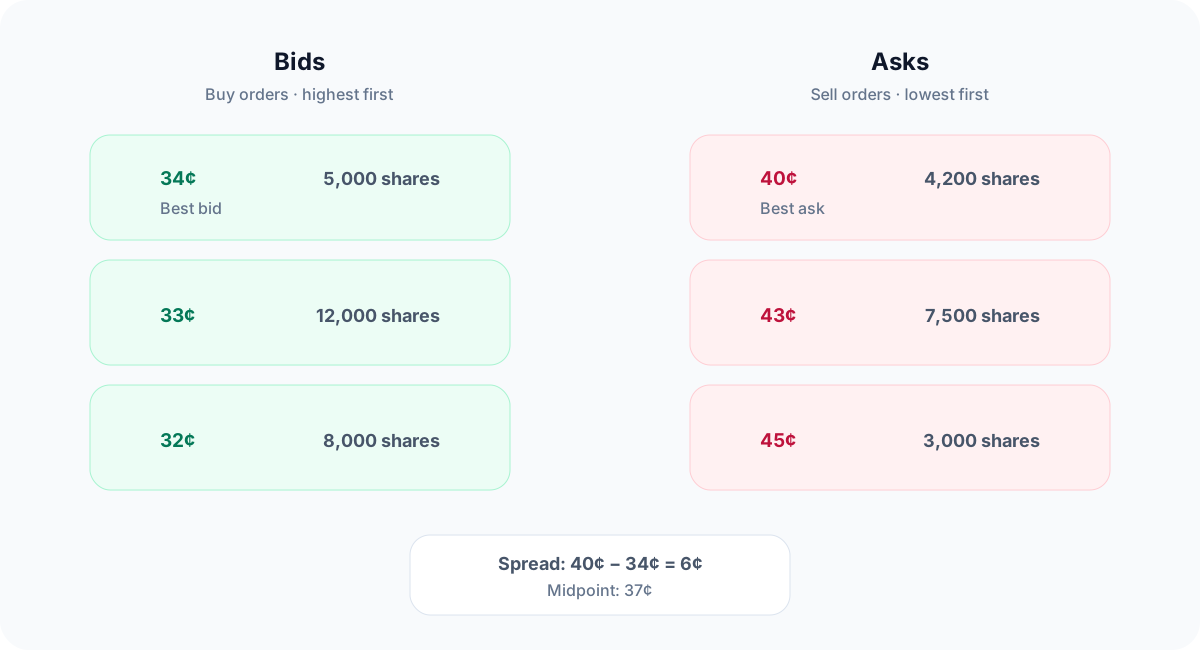
| Term | Meaning |
|---|---|
| Bid | A buy order; the best bid is the highest current offer |
| Ask | A sell order; the best ask is the lowest current offer |
| Spread | The difference between the best ask and best bid |
| Midpoint | The average of the best bid and best ask |
In the illustration, the best bid is $0.34 and the best ask is $0.40. The midpoint is $0.37, but $0.37 is not necessarily executable: a market buyer pays the ask, while a market seller receives the bid.
A narrow spread usually means better liquidity. A large order can consume several price levels, so its average execution price may differ from the first price shown.
Why prices move
- New information changes traders' estimates.
- Filled orders remove liquidity from the book.
- New bids and asks improve or widen the available prices.
- Large orders can move through multiple price levels.
Use a Market order when immediate execution matters. Use a Limit order to set the worst price you are willing to accept.